
Compilation
In this section, you will learn how to:
- understand how compilation chooses the physical scale of an implementation,
- distinguish drive-limited and interaction-limited compilation,
- see why time must be rescaled together with the Hamiltonian
This section describes how QoolQit's compilation maps an abstract programs onto actual hardware.
This page assumes the knowledge of the QoolQit Model page where we introduce the main idea of compilation at a high level: the compiler translates a program, defined in dimensionless units, to the physical scale used to realize it on hardware.
Compilation
Section titled “Compilation”From dimensionless programs to physical hardware
Section titled “From dimensionless programs to physical hardware”A QoolQit program is specified in terms of dimensionless quantities (, , , ). Once the device, and therefore and are fixed, the conversion to physical units is completely determined:
Thus, a given dimensionless program corresponds to one and only one set of physical parameters on a given device.
In the following step, QoolQit adjusts the dimensionless program so that the resulting physical parameters satisfy the device's operational constraints.
Energy scale maximization
Section titled “Energy scale maximization”We will now discuss the compilation strategy that QoolQit uses to rescale the compiled program so that it can both run on a physical QPU and fully exploit its capabilities.
As discussed, the user specifies a dimensionless program by providing a register (which determines the values ) and a time-dependent drive (amplitude, detuning and phase, which determines , , and ). Over all these parameters, two in particular are arguably more important since they set the energy scales of the interactions and of the drive, and thus their ratio. Respectively, they are the maximum interaction and the maximum driving amplitude in the defined program.
Thus, simplifying, we will represent a program as a point in the plane. Interestingly, every program also defines a line through the origin in that plane, with slope . All points lying on the same line are ideally physically identical programs, differing only by a global energy scale factor while preserving the fundamental ratio between driving and interaction strengths.
In addition to the upper bound inherent to the adimensionalization, the device imposes a maximum drive amplitude . Together these define a device allowed region represented as a shaded green rectangle in the figure below:
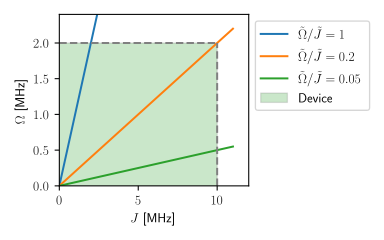
If the user's point lies outside this region, the program cannot be implemented as specified. If it lies strictly inside, the program is feasible but does not exploit the full capability of the device. Compilation resolves both situations by rescaling the program (sliding the point along the line) until it sits exactly on the boundary of the feasible region, maximizing either or , depending on your program.
Concretely, compilation rescales all dimensionless parameters by a common factor :
with chosen as large as possible while keeping the program inside the feasible region. The ratio is preserved by construction, so the dimensionless content of the program — the relative balance between drive and interactions — is unchanged.
Drive-limited compilation
Section titled “Drive-limited compilation”When the ratio is large, the ray hits the line before reaching (blue line above). The compiled program saturates the drive maximum amplitude:
Atoms are placed further apart than the device minimum: the closest pair sits at a dimensionless distance , equivalently at a physical distance .
Interaction-limited compilation
Section titled “Interaction-limited compilation”When the ratio is small, the ray hits before reaching (red line above). The compiled program saturates the interaction bound:
In this case, the closest pair of atoms is placed exactly at the device's minimum spacing , and the drive amplitude remains strictly below the device maximum.
Time scaling
Section titled “Time scaling”The same rescaling argument that adjusts and also forces a rescaling of dimensionless time. This follows directly from the Schrödinger equation.
In physical units,
Because is a fixed device constant, the change of variable rewrites this exactly as
where . The conversion between physical and dimensionless time is therefore fixed by the device, exactly like .
Now consider what happens during compilation. Compilation multiplies the dimensionless Hamiltonian by a factor :
For two programs along the same line to represent the same physics,i.e. to generate the same unitary evolution, the dimensionless time variable must be rescaled by the inverse factor:
Indeed, with this rescaling,
the unitary generated by the rescaled program is identical to the unitary generated by the original program.
Compiling time back to physical units
Section titled “Compiling time back to physical units”Combining the fixed device conversion with the compilation rescaling , a dimensionless duration specified by the user is realized physically in a time
A larger , that is a program with larger amplitude and interaction, yields a shorter physical runtime. This is consistent with the compilation strategy: by maximizing , QoolQit produces the fastest physical implementation compatible with the device constraints.
Special case: a single atom
Section titled “Special case: a single atom”The interpretation above relies on interactions being physically present. For a single atom, however, there are no pairwise interaction terms, so is no longer an intrinsic dynamical scale of the problem.
Mathematically, the dimensionless convention still works exactly as before: one may still define
and rewrite the Hamiltonian in dimensionless form. But in this case, is only a reference scale introduced by convention. It is not a scale that the dynamics can directly probe, because there is no interaction-driven process in the system.
As a result, saying that time is measured "in units of the interaction" remains mathematically valid, but it is not especially informative physically in the one-atom limit.
For a single atom, time should instead be interpreted through the local dynamics generated by the drive and detuning, namely through quantities such as and . For example, when detuning is absent, the natural timescale is the Rabi period set by the drive amplitude. In that regime, the relevant physical question is not how long it takes correlations to spread, but how long it takes the atom to undergo coherent single-particle evolution.