
Control-Z Gate Sequence
Introduction
Section titled “Introduction”In this tutorial we show how to prepare the pulse sequence that generates a Controlled - Z gate. We will prepare our state with atoms in any of the “digital” states that we shall call and ( for “ground” and “hyperfine”, respectively). Then we will use the Rydberg blockade effect to create the logic gate. The levels that each atom can take are the following:

We will be using NumPy and Matplotlib for calculations and plots. Many additional details about the CZ gate construction can be found in 1111.6083v2 (external)
import numpy as npimport matplotlib.pyplot as pltimport qutipfrom itertools import productWe import the following Classes from Pulser:
from pulser import Pulse, Sequence, Registerfrom pulser.devices import DigitalAnalogDevicefrom pulser_simulation import QutipEmulatorfrom pulser.waveforms import BlackmanWaveform, ConstantWaveform1. Loading the Register on a Device
Section titled “1. Loading the Register on a Device”Defining an atom register can simply be done by choosing one of the predetermined shapes included in the Register class. We can also construct a dictionary with specific labels for each atom. The atoms must lie inside the Rydberg blockade radius , which we will characterize by
where the coefficient determines the strength of the interaction ( GHz.). We can obtain the corresponding Rydberg blockade radius from a given using the rydberg_blockade_radius() method from DigitalAnalogDevice. For the pulses in this tutorial, is below Mhz so:
Rabi = np.linspace(1, 10, 10)R_blockade = [    DigitalAnalogDevice.rydberg_blockade_radius(2.0 * np.pi * rabi)    for rabi in Rabi]
plt.figure()plt.plot(Rabi, R_blockade, "--o")plt.xlabel(r"$\Omega/(2\pi)$ [MHz]", fontsize=14)plt.ylabel(r"$R_b$ [$\mu\.m$]", fontsize=14)plt.show()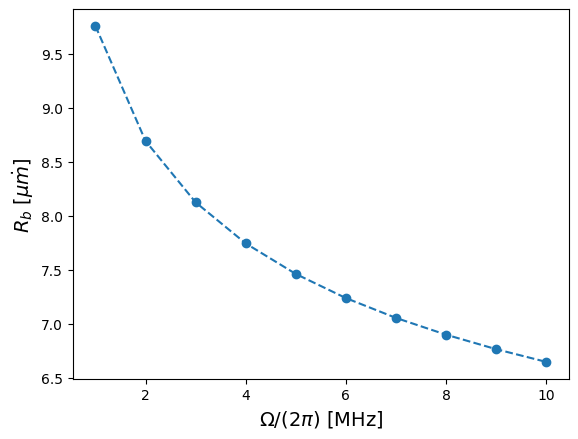
Thus, we place our atoms at relative distances below µm, therefore ensuring we are inside the Rydberg blockade volume.
# Atom Register and Deviceq_dict = { "control": np.array([-2, 0.0]), "target": np.array([2, 0.0]),}reg = Register(q_dict)reg.draw()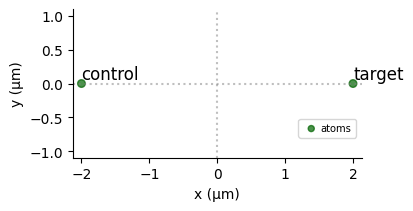
2. State Preparation
Section titled “2. State Preparation”The first part of our sequence will correspond to preparing the different states on which the CZ gate will act. For this, we define the following Pulse instances that correspond to and pulses (notice that the area can be easily fixed using the predefined BlackmanWaveform):
Let us construct a function that takes the label string (or “id”) of a state and turns it into a ket state. This ket can be in any of the “digital” (ground-hyperfine levels), “ground-rydberg” or “all” levels. We also include a three-atom system case, which will be useful in the CCZ gate in the last section.
def build_state_from_id(s_id, basis_name):    if len(s_id) not in {2, 3}:        raise ValueError("Not a valid state ID string")
    ids = {"digital": "gh", "ground-rydberg": "rg", "all": "rgh"}    if basis_name not in ids:        raise ValueError("Not a valid basis")
    pool = {"".join(x) for x in product(ids[basis_name], repeat=len(s_id))}    if s_id not in pool:        raise ValueError("Not a valid state id for the given basis.")
    ket = {        op: qutip.basis(len(ids[basis_name]), i)        for i, op in enumerate(ids[basis_name])    }    if len(s_id) == 3:        # Recall that s_id = 'C1'+'C2'+'T' while in the register reg_id = 'C1'+'T'+'C2'.        reg_id = s_id[0] + s_id[2] + s_id[1]        return qutip.tensor([ket[x] for x in reg_id])    else:        return qutip.tensor([ket[x] for x in s_id])
We try this out:
build_state_from_id("hg", "digital")Let’s now write the state preparation sequence. We will also create the prepared state to be able to calculate its overlap during the simulation. First, let us define a π-pulse along the Y axis that will excite the atoms to the hyperfine state if requested:
duration = 300pi_Y = Pulse.ConstantDetuning( BlackmanWaveform(duration, np.pi), 0.0, -np.pi / 2)pi_Y.draw()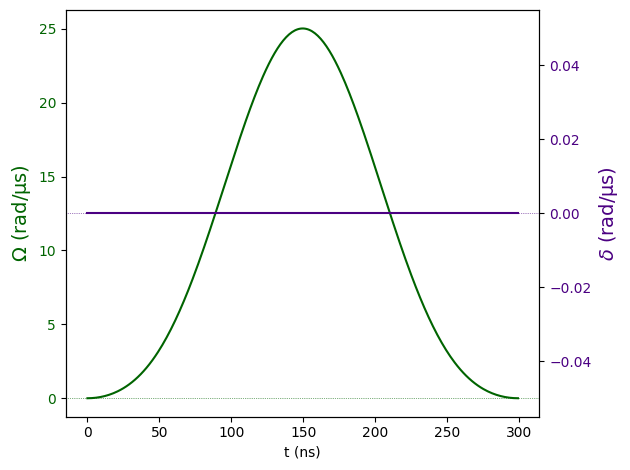
The sequence preparation itself acts with the Raman channel if the desired initial state has atoms in the hyperfine level. We have also expanded it for the case of a CCZ in order to use it below:
def preparation_sequence(state_id, reg):    global seq
    if not set(state_id) <= {"g", "h"} or len(state_id) != len(reg.qubits):        raise ValueError("Not a valid state ID")
    if len(reg.qubits) == 2:        seq_dict = {"1": "target", "0": "control"}    elif len(reg.qubits) == 3:        seq_dict = {"2": "target", "1": "control2", "0": "control1"}
    seq = Sequence(reg, DigitalAnalogDevice)    if set(state_id) == {"g"}:        basis = "ground-rydberg"        print(            f"Warning: {state_id} state does not require a preparation sequence."        )    else:        basis = "all"        for k in range(len(reg.qubits)):            if state_id[k] == "h":                if "raman" not in seq.declared_channels:                    seq.declare_channel(                        "raman", "raman_local", seq_dict[str(k)]                    )                else:                    seq.target(seq_dict[str(k)], "raman")                seq.add(pi_Y, "raman")
    prep_state = build_state_from_id(        state_id, basis    )  # Raises error if not a valid `state_id` for the register
    return prep_state
Let’s test this sequence. Notice that the state “gg” (both atoms in the ground state) is automatically fed to the Register so a pulse sequence is not needed to prepare it.
# Define sequence and Set channelsprep_state = preparation_sequence("hh", reg)seq.draw(draw_phase_area=True)
3. Constructing the Gate Sequence
Section titled “3. Constructing the Gate Sequence”We apply the common sequence for the CZ gate
pi_pulse = Pulse.ConstantDetuning(BlackmanWaveform(duration, np.pi), 0.0, 0)twopi_pulse = Pulse.ConstantDetuning( BlackmanWaveform(duration, 2 * np.pi), 0.0, 0)def CZ_sequence(initial_id): # Prepare State prep_state = preparation_sequence(initial_id, reg) prep_time = max( (seq._last(ch).tf for ch in seq.declared_channels), default=0 )
# Declare Rydberg channel seq.declare_channel("ryd", "rydberg_local", "control")
# Write CZ sequence: seq.add( pi_pulse, "ryd", "wait-for-all" ) # Wait for state preparation to finish. seq.target("target", "ryd") # Changes to target qubit seq.add(twopi_pulse, "ryd") seq.target("control", "ryd") # Changes back to control qubit seq.add(pi_pulse, "ryd")
return prep_state, prep_timeprep_state, prep_time = CZ_sequence( "gh") # constructs seq, prep_state and prep_timeseq.draw(draw_phase_area=True)print(f"Prepared state: {prep_state}")print(f"Preparation time: {prep_time}ns")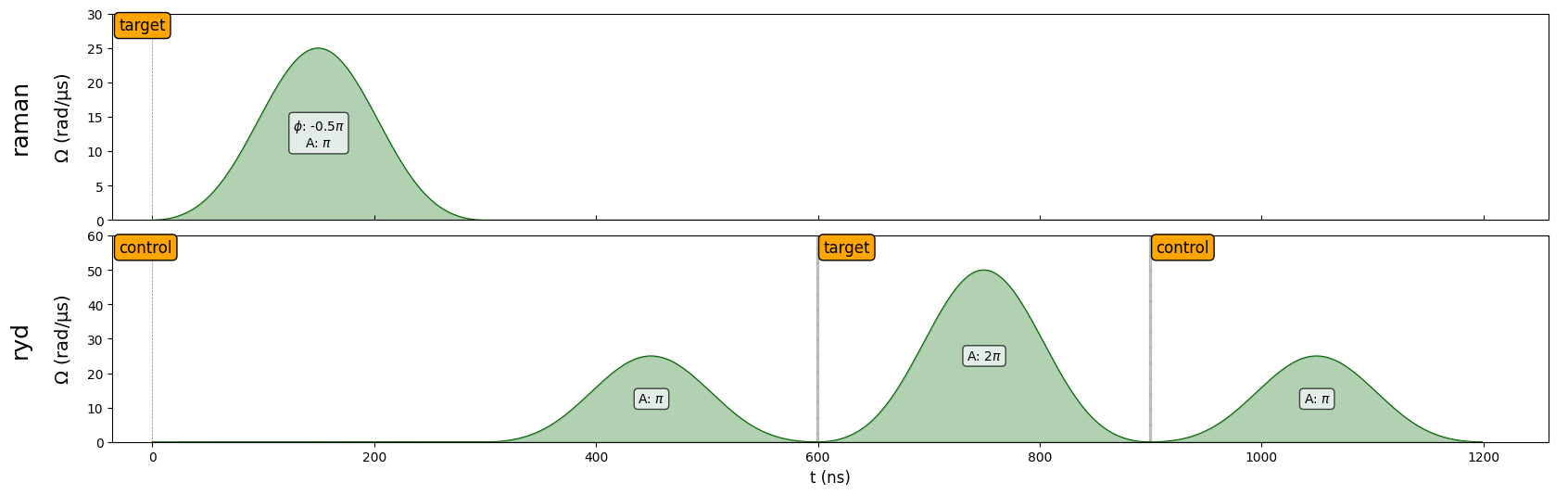
Prepared state: Quantum object: dims = [[3, 3], [1, 1]], shape = (9, 1), type = ket
Qobj data =
[[0.]
 [0.]
 [0.]
 [0.]
 [0.]
 [1.]
 [0.]
 [0.]
 [0.]]
Preparation time: 300ns
4. Simulating the CZ sequence
Section titled “4. Simulating the CZ sequence”CZ = {}for state_id in {"gg", "hg", "gh", "hh"}: # Get CZ sequence prep_state, prep_time = CZ_sequence( state_id ) # constructs seq, prep_state and prep_time
# Construct QutipEmulator instance simul = QutipEmulator.from_sequence(seq) res = simul.run()
data = [st.overlap(prep_state) for st in res.states]
final_st = res.states[-1] CZ[state_id] = final_st.overlap(prep_state)
plt.figure() plt.plot(np.real(data)) plt.xlabel(r"Time [ns]") plt.ylabel(rf"$ \langle\,{state_id} |\, \psi(t)\rangle$") plt.axvspan(0, prep_time, alpha=0.06, color="royalblue") plt.title(rf"Action of gate on state $|${state_id}$\rangle$")
Warning: gg state does not require a preparation sequence.
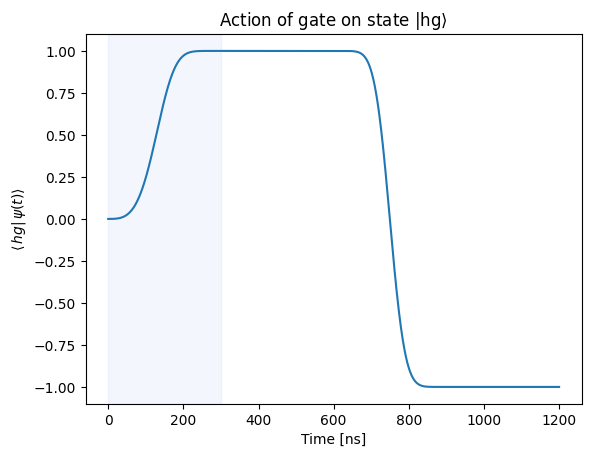
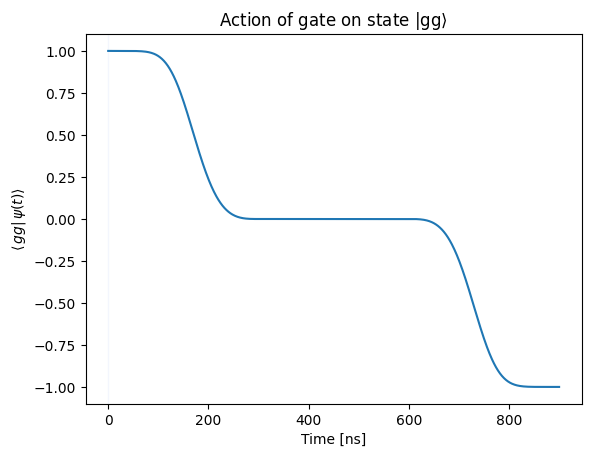
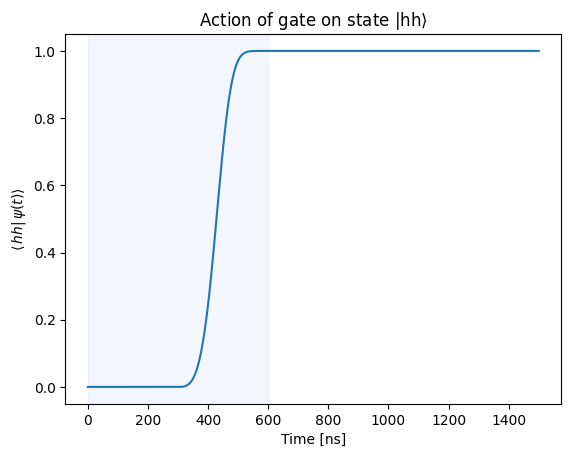
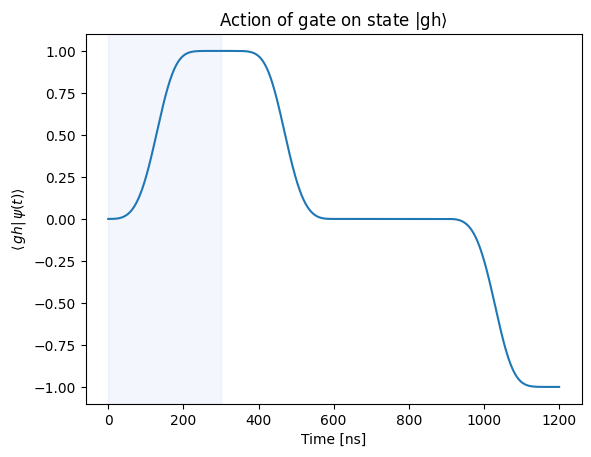
CZ
{'hg': (-0.9999999998457089+1.8369701984375989e-16j),
 'gg': (-0.9990727842456572+0.043053126561342484j),
 'hh': (0.9999999998944231-3.673940397054176e-16j),
 'gh': (-0.9999999997360645+1.8369701982361876e-16j)}
5. CCZ Gate
Section titled “5. CCZ Gate”The same principle can be applied for composite gates. As an application, let us construct the CCZ gate, which determines the phase depending on the level of two control atoms. We begin by reconstructing the Register:
# Atom Register and Deviceq_dict = { "control1": np.array([-2.0, 0.0]), "target": np.array([0.0, 2 * np.sqrt(3.001)]), "control2": np.array([2.0, 0.0]),}reg = Register(q_dict)reg.draw()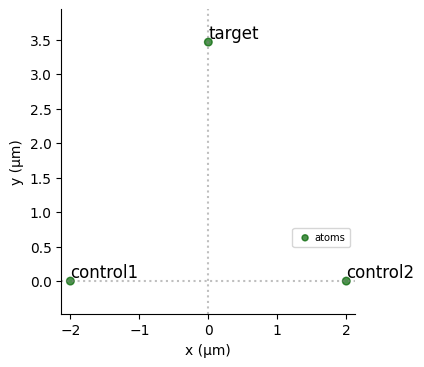
preparation_sequence("hhh", reg)seq.draw(draw_phase_area=True)
def CCZ_sequence(initial_id):    # Prepare State    prep_state = preparation_sequence(initial_id, reg)    prep_time = max(        (seq._last(ch).tf for ch in seq.declared_channels), default=0    )
    # Declare Rydberg channel    seq.declare_channel("ryd", "rydberg_local", "control1")
    # Write CCZ sequence:    seq.add(        pi_pulse, "ryd", protocol="wait-for-all"    )  # Wait for state preparation to finish.    seq.target("control2", "ryd")    seq.add(pi_pulse, "ryd")    seq.target("target", "ryd")    seq.add(twopi_pulse, "ryd")    seq.target("control2", "ryd")    seq.add(pi_pulse, "ryd")    seq.target("control1", "ryd")    seq.add(pi_pulse, "ryd")
return prep_state, prep_timeCCZ_sequence("hhh")seq.draw(draw_phase_area=True)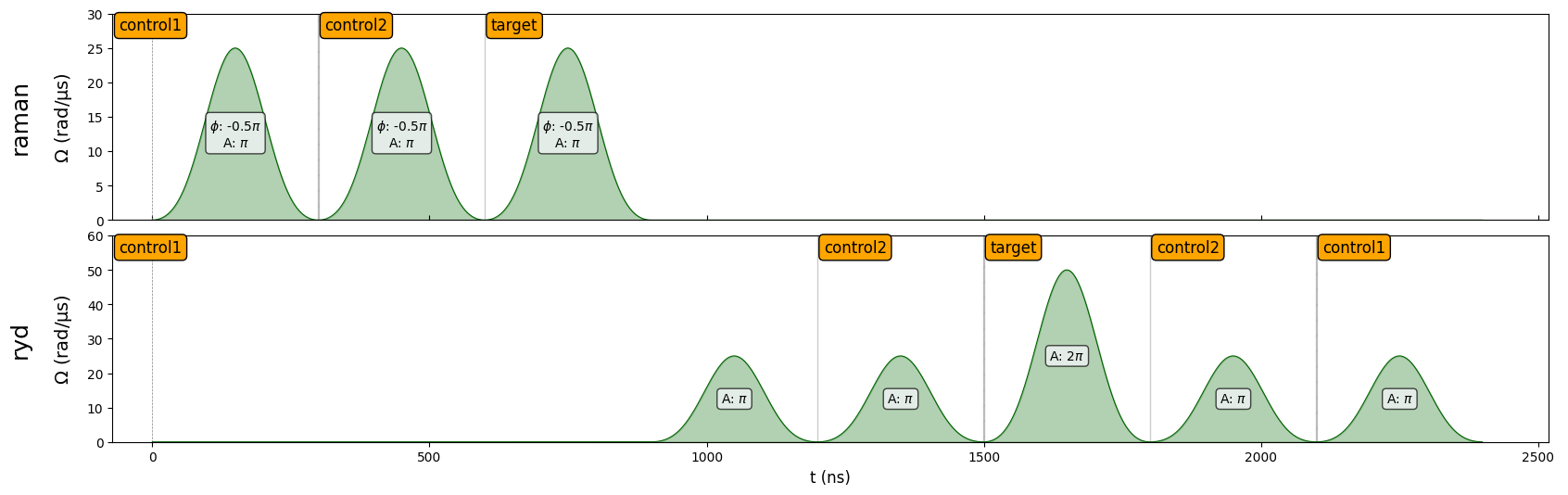
CCZ = {}for state_id in {"".join(x) for x in product("gh", repeat=3)}:    # Get CCZ sequence    prep_state, prep_time = CCZ_sequence(state_id)
    # Construct QutipEmulator instance    simul = QutipEmulator.from_sequence(seq)
    res = simul.run()
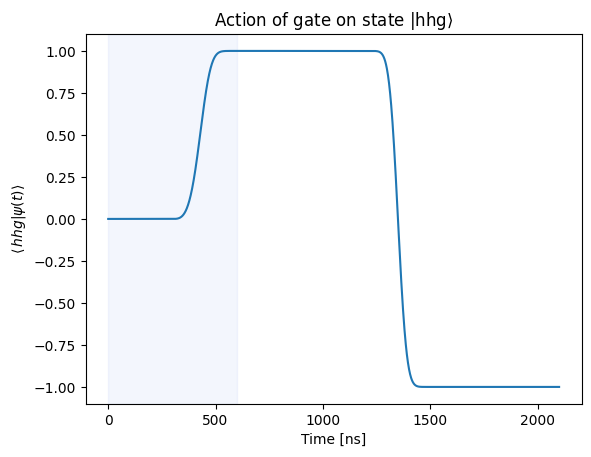
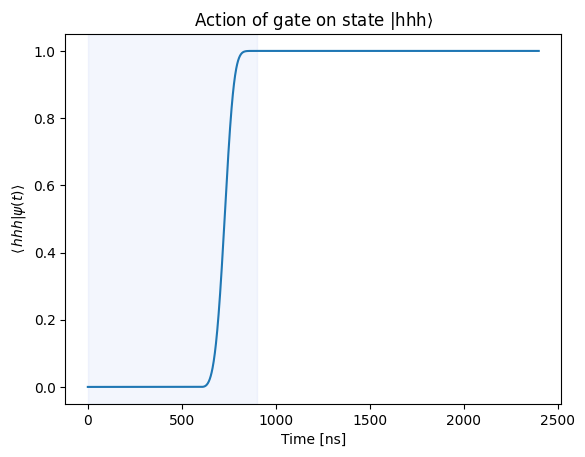
    data = [st.overlap(prep_state) for st in res.states]    final_st = res.states[-1]    CCZ[state_id] = final_st.overlap(prep_state)
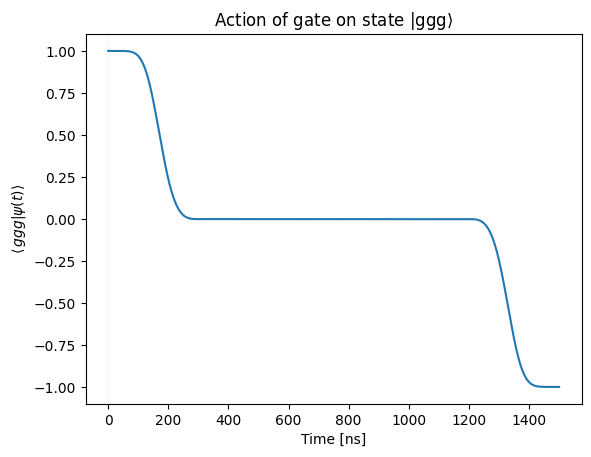
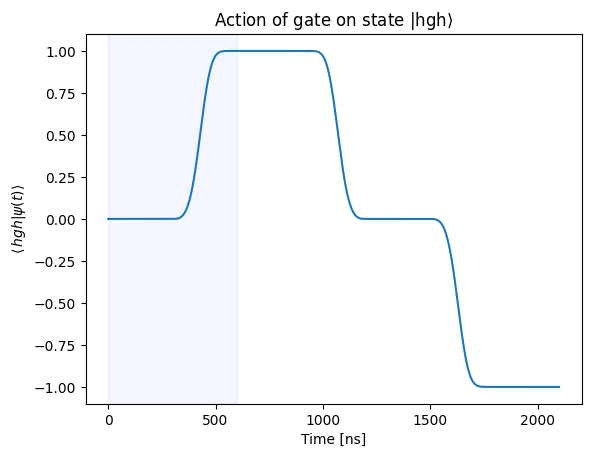
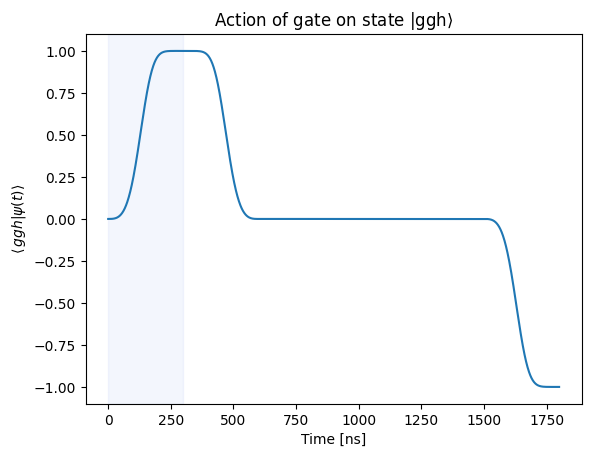
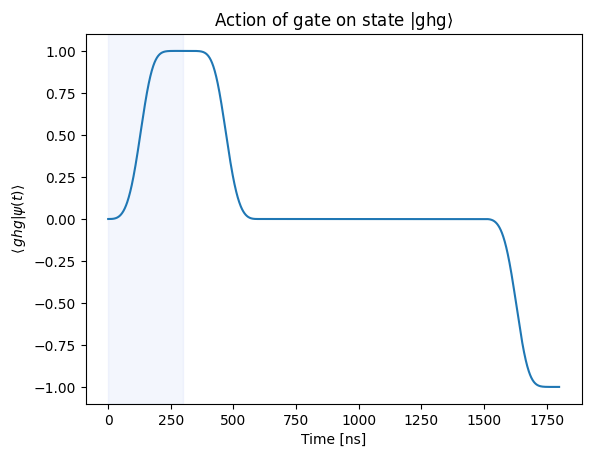
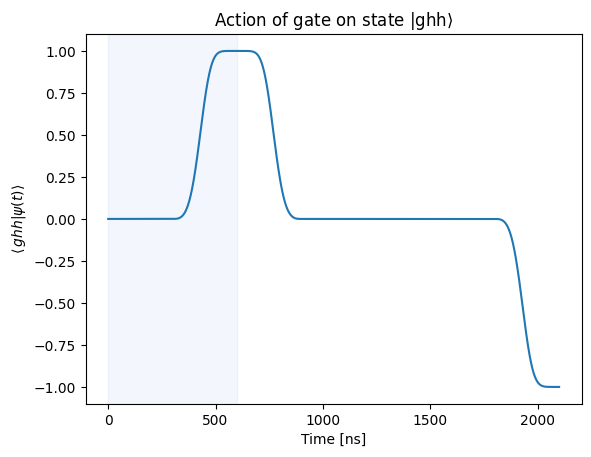
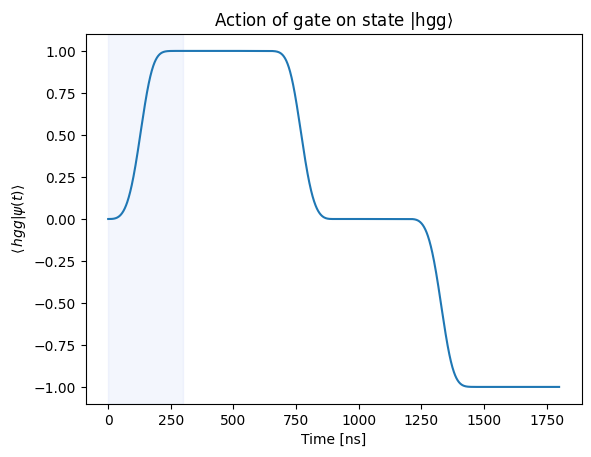
    plt.figure()    plt.plot(np.real(data))    plt.xlabel(r"Time [ns]")    plt.ylabel(rf"$ \langle\,{state_id} | \psi(t)\rangle$")    plt.axvspan(0, prep_time, alpha=0.06, color="royalblue")    plt.title(rf"Action of gate on state $|${state_id}$\rangle$")
Warning: ggg state does not require a preparation sequence.
CCZ
{'hhg': (-0.9999999998988764+3.6739403970705315e-16j),
 'hhh': (0.9999999999508816-5.510910595892429e-16j),
 'ggg': (-0.9979117983013187+0.06459135208264426j),
 'hgh': (-0.9999999965674686+3.673940384831154e-16j),
 'ggh': (-0.9997680593562543+0.02153665345193934j),
 'ghg': (-0.999071360656915+0.04308614932317468j),
 'ghh': (-0.9999999999509961+3.6739403972620576e-16j),
 'hgg': (-0.9990713757542129+0.04308578836890856j)}
Our results are as expected: only the state (which corresponds to a digital state) gets its phase flipped in sign