
Billing
Introduction
Section titled “Introduction”This page explains how billing works on Pasqal Cloud:
- how your project’s credits are tracked,
- how a job’s cost is estimated at submission,
- how the real cost is consumed when the job completes,
- and how billing behaves under third-party cloud integrations (Google Cloud, Azure, OVHcloud, Scaleway).
There are two billing models:
- Credit pools for direct Pasqal Cloud access
- Pay-as-you-go for third-party integrations (Google Cloud, Azure, OVHcloud, Scaleway)
Credit Pool Model
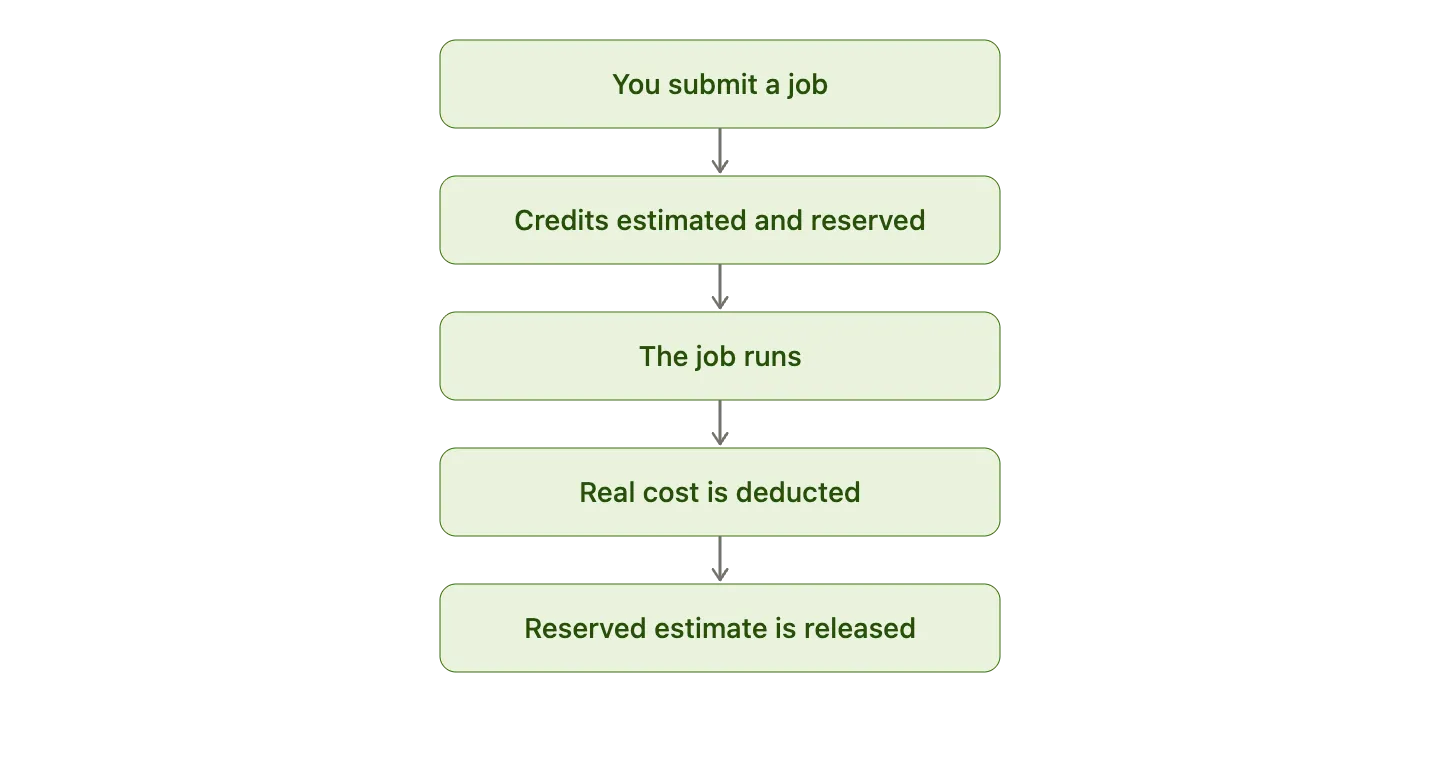
Section titled “Credit Pool Model”Pasqal Cloud projects are billed through contracts, with separate pricing for QPU and emulator backends. Credits are added through credit pools, which may have an expiration date. The job lifecycle drives reservation and consumption.
Key concepts
Section titled “Key concepts”Contract
Section titled “Contract”A contract defines what a project can consume and under which rules: pricing, available credits, and expiration dates. Every project on Pasqal Cloud is attached to a contract.
Pricing per backend
Section titled “Pricing per backend”Each contract has two independent pricing models:
- Emulator: applies to
EMU_MPS,EMU_SV,EMU_TN - QPU: applies to jobs running on a Quantum Processing Unit
A pricing model is defined by:
| Parameter | Description | Possible values |
|---|---|---|
metric | The unit on which billing is based | hour or shot |
price | Number of credits per metric unit | Numeric value |
Examples:
- With
metric = hourandprice = 1, 1 credit buys 1 hour of execution on the selected backend (QPU or emulator). - With
metric = shotandprice = 1, 1 credit buys 1 shot of execution on the selected backend (QPU or emulator).
Credit pools
Section titled “Credit pools”Credits are added through credit pools. A pool has:
- an
amountthe number of credits the pool holds. - an optional
expiry_dateafter that date, remaining credits are not usable.
Whenever credits are added to your project, a new credit pool is created and credits become immediately available.
Other terms
Section titled “Other terms”| Term | Meaning |
|---|---|
| Metric | Unit used to measure billable usage (hour or shot). |
| ECRR | Effective Cycle Repetition Rate of the QPU, used for the 1 shot = 4 s estimation. |
| Soft reservation | Reservation for pending jobs computed dynamically, not stored as a hard lock. |
| Deficit | Portion of a completed job’s real cost that valid pools could not cover. |
| Pay-as-you-go | Billing mode for third-party cloud integrations where usage is reported to marketplaces and no credit checks are done on submission. |
Credit operations
Section titled “Credit operations”Adding credits to your project
Section titled “Adding credits to your project”Credits are added to a project at creation according to the signed contract and can be shot-based or time-based.
By default, added credits are available for one year unless specified otherwise in the contract.
If you have no remaining credits, if credits expired, or if you need additional credits, contact help@pasqal.com.
Job submission
Section titled “Job submission”Process
Section titled “Process”When you submit a job, the billing system:
- Receives job details (creation time, requested shots, backend type, and others).
- Estimates the job consumption.
- Checks remaining credits for the selected backend type.
- If estimate is below remaining credits, job is accepted.
- Otherwise, job is rejected and no billing event is stored.
Estimation
Section titled “Estimation”Estimation is computed at submission time. It serves two purposes: deciding whether the job can be accepted, and accounting for “pending” consumption while the job runs.
When metric is hour
Section titled “When metric is hour”- QPU estimation
1 shot = 4 secondsThis comes from contractual QPU specification (ECRR = 0.25 Hz).
- Emulator estimation
No estimation is currently performed for emulator jobs (estimation = 0), so credits are not reserved for pending emulator jobs.
When metric is shot (QPU only)
Section titled “When metric is shot (QPU only)”Estimation is simply the requested number of shots. In this case, estimation equals real cost.
Computing remaining credits
Section titled “Computing remaining credits”For a backend type (QPU or emulator), the remaining credits formula is:
remaining_credits = sum(valid credit pools) - completed job consumption assigned to those pools - estimated consumption of pending jobsThis value is what determines whether your next job submission will be accepted.
Example: 100 credits total, 30 consumed, 20 estimated pending -> 50 remaining.
Assigning completed jobs to pools
Section titled “Assigning completed jobs to pools”Once a job completes, its real consumption is assigned to credit pools in expiration order — the pool with the earliest expiry date is consumed first.
- Pick the valid credit pool with the closest expiry date.
- If that pool does not hold enough credits to cover the full cost, split the consumption across multiple pools:
- Allocate the remaining credits of the current pool.
- Continue to the next pool (next soonest expiry) until the full cost is covered.
Accepting or refusing a job
Section titled “Accepting or refusing a job”A job is accepted if based on an estimated cost used for soft reservation.
The real cost is only known when the job terminates, so the estimate may end up higher or lower than the final consumption (see “Job Completion” below.)
Job completion
Section titled “Job completion”Process
Section titled “Process”When a job completes successfully:
- Billing receives real consumption (execution time or shots).
- Credits are deducted from one or more pools.
- The credits reserved at job submission are released.
Computing final cost
Section titled “Computing final cost”Job succeeded
Section titled “Job succeeded”- Over-estimation (
estimate > real)
Only the real amount is consumed. The difference is released automatically, because the job is no longer counted in the “pending jobs” set used to compute remaining credits.
- Under-estimation (
estimate < real)
All remaining valid pool credits are consumed in expiry order. If full real cost cannot be covered, uncovered remainder is recorded as a deficit.
Please reach out to help@pasqal.com if you need more credits and this happens.
Third-party integration billing
Section titled “Third-party integration billing”Pasqal Cloud is also available through cloud marketplaces (Google Cloud Marketplace, Azure Quantum, OVHcloud, Scaleway). These integrations use a pay-as-you-go model:
- no credit pools are managed for these projects,
- no credit checks are performed at submission,
- usage is reported periodically to the provider, which invoices the end customer directly.
See also Third-Party Cloud Providers for more details.